
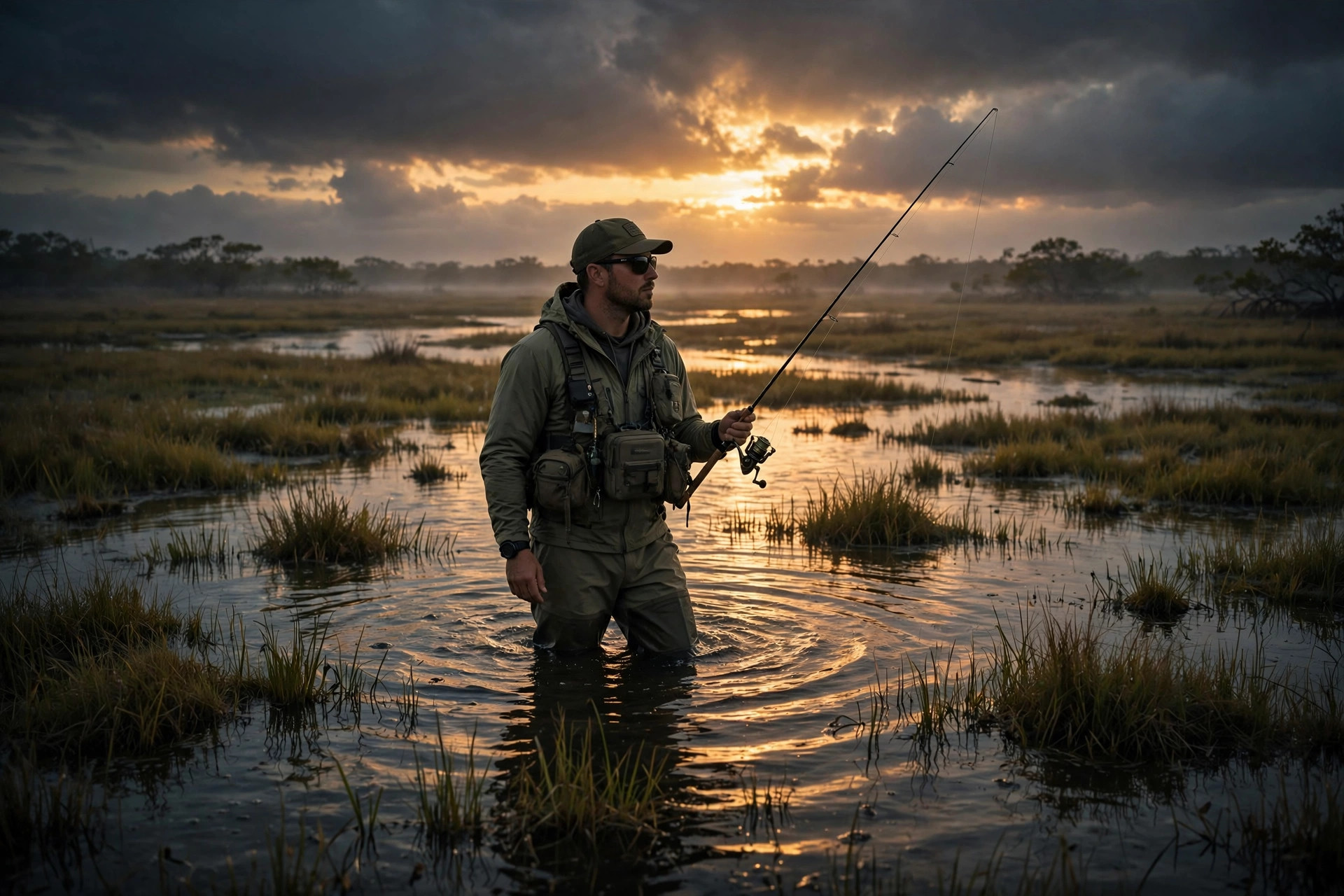
If you want to learn how to catch speckled trout in fall, November is your month. Cooling water concentrates the shrimp and baitfish seatrout live on, the summer crowds are gone, and trout feed hard ahead of winter — including the big “gator” females that slide onto the flats on mild days. This guide covers where they hold as the water cools, and the soft plastics, popping corks, and light tackle that catch them.
Why Fall Is Prime Time for Speckled Trout
Speckled trout are homebodies. NOAA describes the spotted seatrout (Cynoscion nebulosus) as an estuarine-dependent fish that completes its life cycle inside estuaries. Fall simply rearranges them. As temperatures decline, Texas Parks & Wildlife notes, seatrout move off the summer flats toward deeper water — and on the way, they stage wherever food funnels past: flat edges, potholes, creek mouths, and drains. Fish those funnel points and you intercept feeding trout, not loafing ones.
Despite the name, a speckled trout is not a true trout — it belongs to the drum family, like the redfish. Identification is easy: silvery-gray body, distinct black spots scattered over the back and onto the dorsal and tail fins — no other seatrout wears spots on its tail — a soft mouth, and one or two prominent canine teeth. That soft mouth is why trout shake hooks on hard hooksets — and why this guide leans on smooth pressure instead of force.
Where to Find Fall Speckled Trout
Trout ambush over grass and feed into the current. Work these spots in order, and let the temperature tell you how deep to start:
- Grass flats with potholes. The fall home base. Trout hold over seagrass in 2 to 4 feet, ambushing shrimp and pinfish over the potholes — cast to the light holes, not the dark grass.
- Flat edges and drop-offs. Where a flat breaks into a channel, trout stack along the edge on a moving tide. Bigger fish hold deep and slide up to feed.
- Creek mouths and marsh drains. On the falling tide, drains and creek mouths pour bait out of the marsh — a guaranteed trout address while the water moves.
- Deeper holes after a cold front. When a front drops the temperature, trout slide into 4- to 8-foot holes, channel bends, and deep grass, feeding slowly near bottom until the flats warm.
- Docks and lights after dark. Dock lights pull in shrimp and glass minnows; fall trout patrol the shadow line. Cast past the light and work it back through the edge of the glow.
Follow the front, not the calendar
In fall, the weather decides the depth. On mild, sunny afternoons the flats warm fastest, and trout push back into 2 to 3 feet of water to feed — often the best bite of the day. After a cold front, do the opposite: start in the deep holes and channel edges, painfully slow, and follow them shallow only after the sun warms the flat. Give a hard front a day or two, and the shallow bite switches back on.
Best Bait for Fall Speckled Trout
Live shrimp under a popping cork: still the most reliable
A live shrimp under a popping cork is the most dependable trout rig on the Gulf and Atlantic coasts. Set the shrimp 18 to 36 inches under the cork — just above the grass — cast it to potholes and flat edges, and pop the cork sharply every 15 to 30 seconds. The pop mimics a feeding trout and calls fish in; the shrimp does the rest. It is also perfect for new anglers and kids: the cork shows every bite.
Best Lures for Fall Speckled Trout
Soft plastics: the fall workhorse
A 3- to 4-inch paddletail or shrimp-style soft plastic on a 1/8- to 1/4-ounce jighead covers almost every fall situation. Swim it just over the grass, slow, with the occasional twitch; as the water cools, switch to lift-and-drop and let it fall into the potholes — most strikes come on the drop. Natural shrimp, glow, and rootbeer-chartreuse cover clear flats and stained creek mouths alike. The same shrimp imitation under a popping cork twins the live-shrimp rig.
Topwater at dawn, twitchbaits as it cools
Early on calm fall mornings, a small walk-the-dog topwater over the flats draws the most violent strikes of the season — trout hit surface plugs hardest at first light. Once the sun is up or a front has chilled the flats, go subsurface with a suspending twitchbait: two twitches, then a long pause. Cold-water trout stare at a still bait for seconds before eating — stretch the pause before you shorten it.
Light Tackle That Protects a Soft Mouth
A 7-foot medium-light spinning rod with a 2500–3000 reel, 10- to 15-pound braid, and a 20-pound fluorocarbon leader is the standard setup — light enough for small plastics all day, strong enough for a gator. Technique beats gear: sweep to set the hook instead of snapping it, keep steady pressure, and lead the fish to the net without lifting its head from the water. One hard head-shake at the boat loses more big trout than everything else combined.
Log the Tide Stage and the Pattern Repeats
Fall trout run on tide stage and temperature: a creek mouth that fires on the first two hours of the falling tide often repeats at the same stage tomorrow. Log tide stage, water temperature, and depth with each trout in your COUNT THE CATCH journal, and within a few trips you stop running the whole bay — you rotate a short list of flat edges, drains, and deep holes, each on its tide.
Key takeaway: In fall, speckled trout move from summer grass flats toward deeper water — staging at every funnel point. Fish potholes and flat edges on mild days, deep holes slowly after a front, and let a popping cork or a soft plastic do the catching. Browse tournaments on COUNT THE CATCH →
Know Your Slot: Florida Rules Vary by Region
Florida manages spotted seatrout by region — check the current FWC rules for yours first (start at our resources page). Every region uses a 15- to 19-inch slot, but bag limits run from 2 to 5 fish by region: most regions allow one fish over 19 inches per vessel, while the Northeast and Indian River Lagoon regions allow none — and Indian River Lagoon is closed November 1–December 31. Other states differ. Our tournament measuring guide settles any borderline fish in seconds. Release over-slot “gators” even where legal: the biggest are almost all females, the bay's top spawners. Wet your hands, support it horizontally, and let it swim off strong.
Go Work a Grass Flat This Week
Pick a grass flat with potholes and a deep edge, start on the falling tide with a soft plastic or shrimp under a cork, and note your first trout's depth. After the next front, come back and start in the deep hole. That is the whole fall playbook: shallow on warm days, deep and slow after the front — and November is when it pays best. Tight lines, and we will see you on the leaderboard.